You may down-load this for your
personal use. Duplicating or publishing
any
part of this document for commercial use,
without written permission, is strictly
prohibited.
I receive a lot of questions about how to
install a spa; what is needed, and what
may be done to prepare for the spa.
Because our spas are made in the best
possible fashion, with modern acrylic,
and painstaking fiber-glassing, The spas
must be placed on a solid flat surface.
<> We recommend either a concrete
slab, or a deck with concrete caissons.
With a concrete pad it is preferred to
place it on a well compacted and level
ground. We recommend at least 4 inches
thick, and be reinforced. Spas can weigh
close to 5,000 pounds. The concrete should
not have any relief cuts into the surface
for stress cracking. The reason for this
is so the slab will not separate under the
spa, but will work like a huge flat table
if the ground shifts. We do not want the
spa the become distorted.
In some parts of the country, the
ground is very stable, and you may be
able to use other support systems. I
prefer to recommend the best possible
platforms, for any area of the country.
Check with your local building
department for their opinion on the
ground. In Colorado, where our store is,
the base has to be supported by
concrete, because the ground is an
unstable mixture of soft and hard
materials.
Nearly all spa warranties have a
disclaimer for improper installations
that cause shell cracking, from
distorted platforms.
It is a good idea to have a plan for
how you want the spa to be oriented, so
the best seats are aligned with
something you like to look at. (I like
looking up at the stars, and out towards
the mountains).
If the spa is to be out in the open, we
recommend that the platform be big
enough for an extended area in front of
the spa for the steps and a place to
hang your robes. If you are concerned
about the appearance of a large concrete
slab, you can have the slab go just
under the spa, and place stonework
around the spa, and in the front for the
entrance area. The steps we include with
our spas are 23 inches out from the spa
and 30 inches wide. If the spa has a
"cut corner" design with the step in at
the cut corner, the slab has to be big
enough to accommodate the steps at the
corner.
If you plan to have a gazebo, you may
want the concrete to extend to the outer
walls of the gazebo, or place concrete
"footers" where the gazebo structural
posts will go.
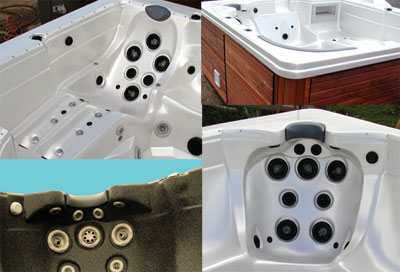
If you want hidden electrical conduit,
you can have the electrician bring the
conduit up through the concrete, into
the bottom of the spa. With thermal pane
spas, this is an easy thing to do,
because there are many places inside the
spa where the electrical conduit can be
brought in. (Another reason to stay away
from fully foamed spas)
If you are planning to have a cover
removal device like our SuperLift2, plan
an area behind the spa at least 15
inches of clear space for the cover to
tilt off the spa. 18 inches is even
better.
Plumbing Considerations
Portable spas do not need any connections
to either water or drain. They
simply fill with a garden hose and drain
with a garden hose. You can also us
a sump pump for quick draining.
Using Instant Ions or Eco One allows you
to drain the spa directly on the ground
and the water can be used to water plants.
If you are installing a potable spa in a
room, it needs a water proof floor, a
drain and the fixtures in the room must be
water/ steam proof, like in a locker
shower room.
Electrical Considerations.
I worked as an electrician ( as well as an
electronics technician and engineer) for
years, before getting into the spa
business, so I understand the installation
procedures from both the electrician's and
the spa installers viewpoints. There are
many electricians, who do not fully
understand the operation of spas, and how
a spa has a different need than say and
electric clothes dryer.
One of the main concerns with a spa is
the power requirements for water pumps.
Because water pumps have a rather heavy
current draw during the motor starting,
it is recommended to use a larger wire,
than is commonly used. I have seen many
newly constructed custom houses with too
small wire for the powerful two and
three pump spas being offered today. We
recommend using Number 6 copper wire for
your spa. If you look inside the control
box of most modern spas, they are built
with lugs for number 6 copper wire. Even
if the electrical requirements for the
spa you get now is for a smaller wire,
you may consider trading up to a more
powerful spa in the future.
The other concern is the length of
run. With water pumps the wire size gets
larger with distance, more so than with
any resistive load. I can recall
installing a 240 volt irrigation pump
with number 6 copper for a 100 foot run;
even thought the breaker size was 20
Amps. The nature of the reactive rating
on the pump motor called for a large
wire to allow full energy to the
motor.
It is also a good idea to keep the
electrical run from the GFCI to the spa
as short as possilbe to eliminate ground
faults that trip the GFCI from moisture
in conduit.
Too small of a wire, can cause the motors
to have a lower voltage at starting, and
shorten the life of the motors. In spa
wiring, if you use a sheathed cable
(romex) the wire size must be increased
one size. The heat retention of a closed
cable cause more heat build up. Click
Here
for Electrical Specs on Haven Spas
|
Ground
Fault
Safety considerations:
A Ground Fault Circuit Interrupter,GFCI,
is an electrical safety device required by
the National Electrical Code to be
installed on all spas after January
1,1994. It basically senses an electrical
current going straight to ground, often
indicating electricity in the water. These
GFCI's are set to a very low amount of
electrical current. I don't believe I
could feel 0.5 MA of electricity, but that
is how sensitive they are. The concept is
to stop even the slightest possibility of
getting electricity touching your body. A
good concept!!
We have found that two pole GFCI
breakers, the standard types used inside
load centers (main panels and sub
panels) do not work very well on spas.
There is a phenomenon called "false
tripping", that drives spa repair people
and spa electricians crazy.
I have (as an experiment) replaced an
entire spa equipment package, in order
to prove that the false tripping GFCI
breaker was the problem. The electrician
(who had not installed many spas) told
me that the breaker was tripping because
of a problem in the spa. The funny thing
is we have many of the same equipped
spas that do not have a false tripping
problem on a GFCI disconnect. I have
heard of things such as garage door
openers that cause the spa's GFCI
breaker to trip. (That must have been a
time waster to locate!!)
Because of the reactive loads that
spas present, and the fact that parts of
the spa run on 115 volts, the GFCI
breakers "think" that a normal spa
condition is a ground fault and trip for
no measurable reason. The breakers also
go bad with time. It seems that spas are
rough on these GFCI Breakers.
This is not a fun thing to deal with!
In the winter it can lead to frozen
spas!
I know that it took a long time to
develop GFCI breakers and they barely
work on spas. I personally do not think
it is possible to make one, because no
one has (Still in 2005) made one that
works for a long time on a high
performace spa. It seems that unless the
spa has no 115 volt components, and the
spa has less than two pumps, the odds of
the GFCI breaker false tripping in time
are 100%. I have seen capacitors applied
to stop the back feed of electricity to
the chassis of motors, so the GFCI
doesn't "think" the magnetic lines of
flux crossing the metal frame are not a
ground fault.
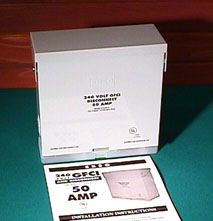
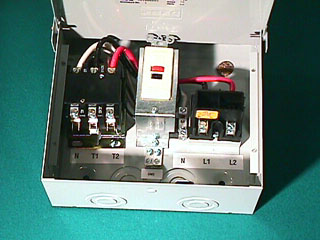
There is an answer. It is called the
GFCI disconnect. This device is not a
"breaker". It does not trip because of
an over-current. It is strictly a ground
fault detector. It consists of a high
current GFCI that drives a three pole
contactor. If there is a ground fault,
it turns off the contactor and
disconnects all three lines. The two
"hots" and the neutral. It is UL listed,
and comes with its own outdoor box. If
you can't find one, we distribute them.
The best way to install them is this
way. Place a standard 50 or 60 amp two
pole breaker in the house load center.
Run conduit out to the GFCI, then
conduit to the spa. The GFCI needs to be
available to the spa, and not locked in
another room. Ask the building
department in your area about placement.
The electricians like them, and I like
them. They are easy to install, with
lots of room for the number 6 wires to
bend.
So far, I have not seen one "false
trip". I have seen them trip and shut
off power with reason; usually water in
the ozonator. (We finally had one
in 2003!. that is one out of
approximately 2400 we have sold.)
When ever I have the chance to talk
with my customer's electrician, I talk
them out of using a GFCI breaker and
into using a GFCI disconnect. I simply
say: "If the breaker trips, you will be
the first person to go out and waste
your time." If the GFCI disconnect
trips, then I'll be the first to send
someone out." The worst case so far was
$577 paid to a spa repair service
company to fix a spa under warranty that
was not defective. If the spa is fine,
there is no warranty. The GFCI
breaker was the problem, but the
electrician insisted there was nothing
wrong with the breaker. So,
eventually we got another electrician
out to fix the problem by removing the
faulty GFCI breaker and replacing
it. The customer also had to pay
the electrician. That is an
expensive lesson that I do not want to
put on my customers.
This GFCI has been temporarily
discontinued. The economy has
taken its toll.
Click
Here to Order Your GFCI Disconnect
|